Vipulse Corporate Website
A multilingual website and publishing system for electronics manufacturing

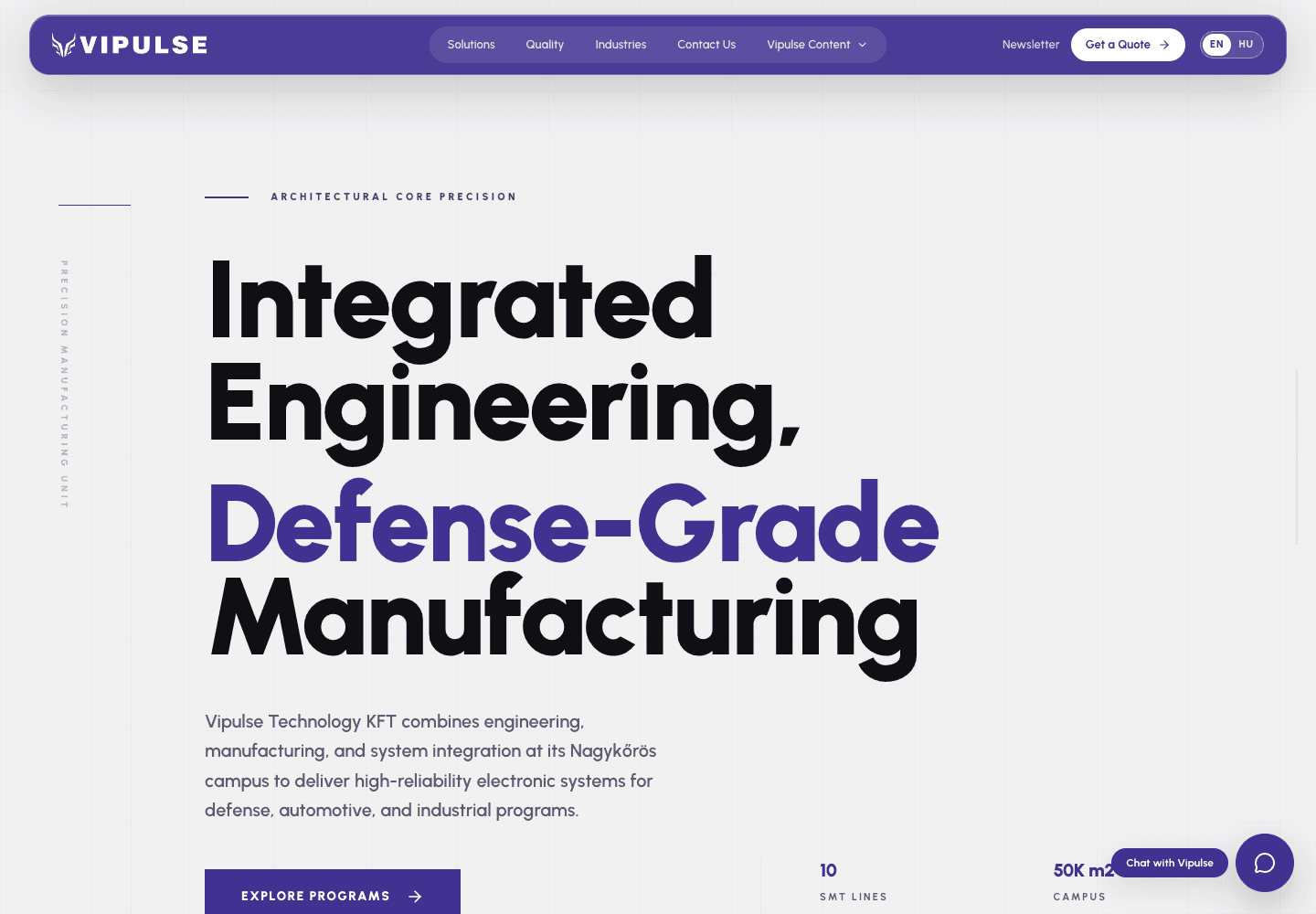
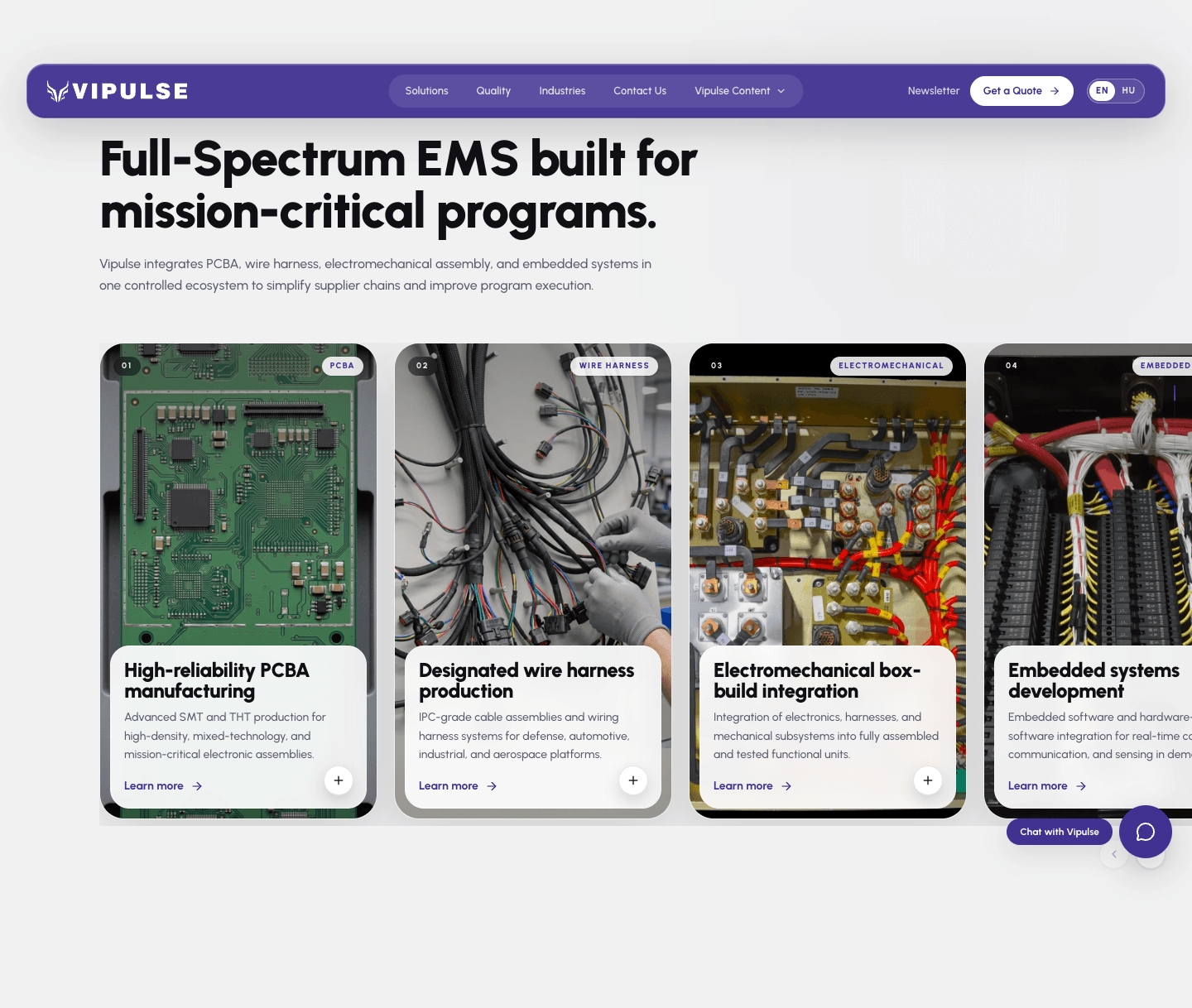
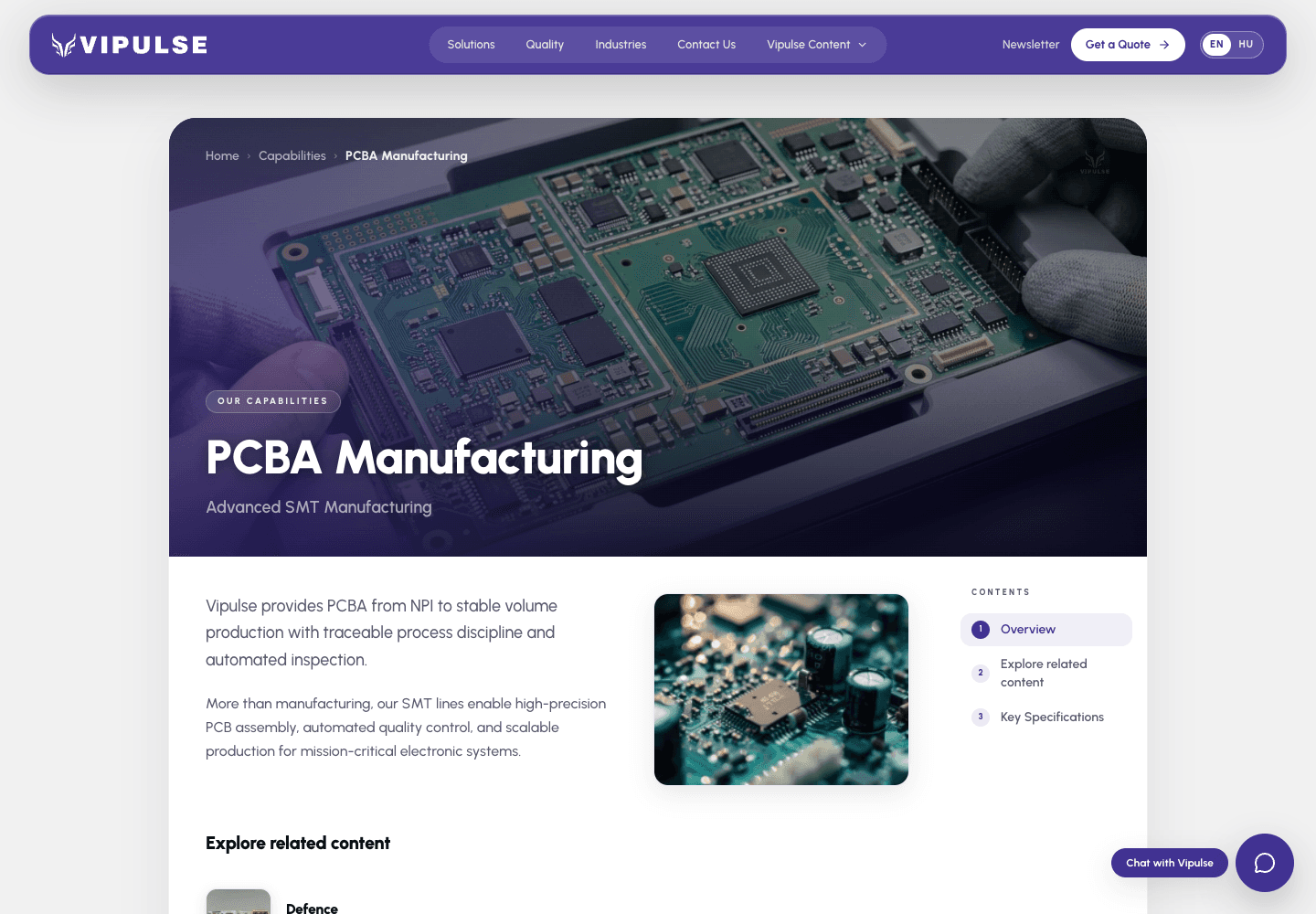
Vipulse production home page
Designing for technical buyers
Vipulse manufactures electronic assemblies. Its customers need to understand manufacturing capabilities, quality processes, supported technologies and how to start a conversation about a real production requirement.
I designed the information architecture around those questions. Service pages lead with the manufacturing problem, show the relevant process and capability, then make the next step clear. Shared modules keep technical specifications, quality information and calls to action consistent without making every page look identical.
The visual system uses strong technical photography, restrained motion and a compact industrial interface. I built responsive layouts for phones first, then expanded the compositions for larger screens where detailed process and capability content has room to breathe.
English and Hungarian content
The website has separate English and Hungarian routes and separately authored content. I did not treat localization as a string-replacement layer. Editors can control page titles, descriptions, body content, calls to action and search metadata for each language.
Routing, canonical URLs, alternate-language links, sitemaps and structured data all follow the selected locale. That gives search engines a clear relationship between the two versions and lets the company write naturally for each market.
A CMS the company can operate
I built the publishing system with Payload CMS and PostgreSQL. Collections cover pages, capabilities, services, media, navigation and site settings. Reusable blocks give editors flexibility while keeping layout and content rules inside a controlled system.
Drafts and preview URLs let the team review a change before it is public. Roles and collection access rules separate ordinary publishing from administrative changes. Media, slugs and required metadata are validated before publication, and migrations keep the database schema tied to the application version.
Search foundations in the application
Each route generates its own title, description, canonical URL, language alternates and social-sharing metadata. The application also generates XML sitemaps, robots rules and schema markup for the company and its services.
I built semantic heading structures, descriptive image text and stable URLs into the page components rather than adding them after the visual work. The same CMS fields feed visible content and metadata, which reduces the chance of the page and its search description drifting apart.
Lead capture and abuse controls
The contact flow validates input on both the client and server. Public forms use rate limiting and bot controls before creating a record or sending a notification. Resend handles transactional email, while PostgreSQL keeps the submitted lead and its status available to the team.
Secrets stay in the deployment environment. The browser never receives email credentials, database access or protected API keys. Error responses are useful to the visitor without exposing provider or application details.
Analytics and releases
Google Analytics loads according to the visitor's consent choice. The consent state is separated from ordinary interface state, and non-essential analytics do not run before that choice.
Every change receives a Vercel preview so content, responsive layout and form behaviour can be reviewed before production. Type checking, linting and the production build run as release gates. The same application and CMS code move through preview and production with environment-specific databases and secrets.
I took the project from structure and visual direction through the Next.js application, CMS, database, analytics, lead handling and deployment. The result is a website the company can publish through directly instead of asking an engineer to edit page code.
Built with
- multilingual routing
- international SEO
- structured data
- content modelling
- role-based access
- preview deployments
- consent management
- rate limiting
- lead capture